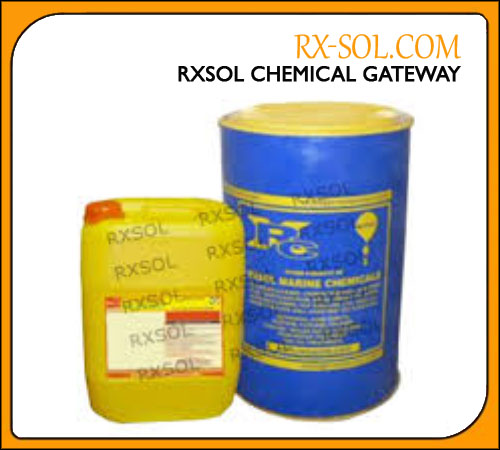
Sodium Thiosulfate Pentahydrate Solution
Part No: RXSOL-12-2031-220
Important solvent as eletrical parts cleaner
MSDS

| Product Name | RXSOL CLEANER |
| Part Number | RXSOL-19-1340-210 |
Company Details:
RX MARINE INTERNATIONAL
105, A WING , BSEL , TECH PARK.
VASHI ,NAVI MUMBAI 400703 INDIA
BRANCH : Kandla , Mumbai, Chennai, Vizag, Haldia, Kolkata, Fujairah UAE and Oman
| Phone | +91 22 27815540 / 41 / 42 |
| Fax | +91 22 2781 5543 :::AOH :0091 9821214367 |
| mail@rxmarine.com | |
| Website | www.rxmarine.com |

| Name of Substance | Cas Number | EC Number | Weight % |
| Isopropyl Alcohol | 67-63-0 | 200-661-7 | 80 - 90 % |
| Surfactant | Proprietary | - - - - - - | 10 - 20 % |

| Signal Word | Warning |
| Hazard Statements |
H319 Causes serious eye irritation. H336 May cause drowsiness or dizziness. |
| Precautionary statements - prevention |
P210 Keep away from heat, hot surfaces, sparks, open flames and other ignition sources. No smoking. |
| Precautionary statements - response |
P305 + P351 + P338 IF IN EYES: Rinse cautiously with water for several minutes. Remove contact lenses, if present and easy to do. Continue rinsing. Storage : P403 + P233 Store in a well-ventilated place. Keep container tightly closed. |
| Carcinogenicity | Not classified as human carcinogen. |

| Skin Contact | Wash off immediately with plenty of water for at least 15 minutes. Immediate medical attention is required. |
| Eye Contact | Rinse immediately with plenty of water, also under the eyelids, for at least 15 minutes. Obtain medical attention. |
| Inhalation: | Move to fresh air. If not breathing, give artificial respiration. Get medical attention ifm symptoms occur. Risk of serious damage to the lungs. |
| Ingestion | Clean mouth with water and drink afterwards plenty of water. Do not induce vomiting. Call a physician or Poison Control Center immediately. If vomiting occurs naturally, have victim lean forward. |
| Most important symptoms/effects | Breathing difficulties. Symptoms of overexposure may be headache, dizziness, tiredness, nausea and vomiting. |
| Notes to Physician | Treat symptomatically |

| Suitable extinguishing media | Foam, Carbon dioxide (CO2), Dry powder |
| Unsuitable extinguishing media | For this substance/mixture no limitations of extinguishing agents are given. |
| Special hazards arising from the substance or mixture | Risk of ignition. Vapors may form explosive mixtures with air. Vapors may travel to source of ignition and flash back. Containers may explode when heated. |
| Hazardous Combustion Products | Carbon monoxide (CO), Carbon dioxide (CO2), peroxides. |
| Advice for firefighters | As in any fire, wear self-contained breathing apparatus pressure-demand, MSHA/NIOSH (approved or equivalent) and full protective gear. Thermal decomposition can lead to release of irritating gases and vapors. |
| Further Information | Remove container from danger zone and cool with water. Prevent fire extinguishing water from contaminating surface water or the ground water system. |

| Personal precautions | Use personal protective equipment. Remove all sources of ignition. Take precautionary measures against static discharges. Avoid contact with skin, eyes and clothing |
| Environmental precautions | Should not be released into the environment. Do not let enter product in drain. |
|
Methods and material for containment and cleaning up |
Prevent further leakage or spillage if safe to do so. Remove all sources of ignition. Soak up with inert absorbent material. Take precautionary measures against static discharges. Use spark-proof tools and explosion-proof equipment. Keep in suitable, closed containers for disposal. |
| Reference to other sections | Indications about waste treatment see section 13. |

| Handling | Wear personal protective equipment. Keep away from open flames, hot surfaces and sources of ignition. Use explosion-proof equipment. Use only non-sparking tools. Take precautionary measures against static discharges. Do not get in eyes, on skin, or on clothing. Do not breathe vapors or spray mist. To avoid ignition of vapors by static electricity discharge, all metal parts of the equipment must be grounded. |
| Storage | Keep containers tightly closed in a dry, cool and well-ventilated place. Keep away from heat and sources of ignition. Flammables area. Corrosives area. |
| Hygiene measures | Handle in accordance with good industrial hygiene and safety practice. Keep away from food, drink and animal feeding stuffs. Do not eat, drink or smoke when using this product. Remove and wash contaminated clothing before re-use. Wash hands beforebreaks and at the end of workday |

| Engineering Control | Provide exhaust ventilation or other engineering controls to keep the airborne concentrations of vapors below their respective threshold limit value. Ensure that eyewash stations and safety showers are proximal to the work-station location. |
| Personal Protection |
Eye/face Protection : Wear appropriate protective eyeglasses or chemical safety goggles as described by OSHA's eye and face protection regulations in 29 CFR 1910.133 or European Standard EN166. |
| Exposure Limits | Contains no substances with occupational exposure limit values. |


Gloves Suit

| Form | Liquid |
| Colour | Colourless |
| Odour | Alcohol like |
| Odor Threshold | 1.0 - 196.1 ppm |
| pH at 20°C | Neutral |
| Melting Point | - 80 °C |
| Boiling Point | 95 °C |
| Flash Point | 72 °C |
| Evaporation Rate | No information available. |
| Flammability (solid, gas) | No information available. |
| Density | 0.795 - 0.81 at 20 °C |
| Relative Density | No information available |
| Decomposition Temperature | No information available |
| Partition coefficient | No data available |
| Autoignition Temperature | No information available |
| Solubility in Water | Soluble in any ratio |
| Explosive properties | Not classified as explosive. |
| Oxidizing properties | None |

| Recativity Hazard | None known, based on information available |
| Stability | Product is stable. |
| Possibility of hazardous reactions | Hazardous Polymerization Hazardous polymerization does not occur. Hazardous Reactions None under normal processing. |
| Conditions to avoid | Heat, flames and sparks. Keep away from open flames, hot surfaces and sources of ignition |
| Incompatible materials | Strong oxidizing agents. Acids. Halogens. Acid anhydrides. |
| Hazardous Decomposition Products | Carbon monoxide (CO). Carbon dioxide (CO2). peroxides |

| Acute oral toxicity |
LD50 Rat: 5,045 mg/kg (RTECS) Symptoms: Risk of aspiration upon vomiting., Aspiration may cause pulmonary oedema and pneumonitis. |
| Acute dermal toxicity |
LD50 Rabbit: 12,800 mg/kg (RTECS) |
| Skin Irritation |
Skin irritation Rabbit Result: No skin irritation OECD Test Guideline 404 Drying-out effect resulting in rough and chapped skin. |
| Eye Irritation |
Eye irritation Rabbit Result: Eye irritation OECD Test Guideline 405 Causes eye irritation. |
| Specific target organ toxicity - repeated exposure | This information is not available. |
|
Aspiration hazard |
This information is not available. |
| Further information |
After absorption: Headache, Dizziness, inebriation, Unconsciousness, narcosis After uptake of large quantities: respiratory paralysis, Coma Other dangerous properties can not be excluded. Handle in accordance with good industrial hygiene and safety practice. |

| Toxicity |
Toxicity to fish |
| COD and BOD 5 |
Ratio BOD/ThBOD BOD5 49 % (IUCLID) Ratio COD/ThBOD 96 % (Lit.) |
| Products of Biodegradation: |
95 %; 21 d; aerobic OECD Test Guideline 301E Readily biodegradable |
| Mobility in soil | No information available. |
| Results of PBT and vPvB assessment | No information available. |
| Other adverse effects | Discharge into the environment must be avoided. |

| Waste treatment Method | Waste material must be disposed of in accordance with the national and local regulations. Leave chemicals in original containers. No mixing with other waste. Handle uncleaned containers like the product itself. |

DOT
| UN Number | UN1219 |
| Proper shipping name | Non Corosive Substance, RXSOL Cleaner |
| Hazard Class | 3 |
| Packing group | III |
TDG
| UN Number | UN1219 |
| Proper shipping name | Non Corosive Substance, RXSOL Cleaner |
| Hazard Class | 3 |
| Packing group | III |
IATA
| UN Number | UN1219 |
| Proper shipping name | Non Corosive Substance, RXSOL Cleaner |
| Hazard Class | 3 |
| Packing group | III |
IMDG/IMO
| UN Number | UN1219 |
| Proper shipping name | Non Corosive Substance, Rxsol Cleaner |
| Hazard Class | 3 |
| Packing group | III |
| Marine Pollution | None |
Environmental hazards : No hazards identified
Special precautions for user : No special precautions required
Transport in bulk according to Annex II of MARPOL73/78 and the IBC Code : Not applicable, packaged goods

|
Safety, health and environmental regulations/legislation specific for the substance or mixture |
National legislation Storage class 3 |
| Chemical Safety Assessment | A Chemical Safety Assessment has been carried out according to regulation (EC) No. 1907/2006 (REACH) for this substance. |

| Other Information |
The information above is believed to be accurate and represents the best information currently available to us. However, we make no warranty of merchantability or any other warranty, express or implied, with respect to such information, and we assume no liability resulting from its use. Users should make their own investigations to determine the suitability of the information for their particular purposes. In no event shall be liable for any claims, losses, or damages of any third party or for lost profits or any special, indirect, incidental, consequential or exemplary damages, howsoever arising, even if RX Marine International has been advised of the possibility of such damages. DISCLAIMER OF LIABILITY :The information in this SDS was obtained from sources which we believe are reliable. However, the information is provided without any warranty, express or implied, regarding its correctness. The conditions or methods of handling, storage, use or disposal of the product are beyond our control and may be beyond our knowledge. For this and other reasons, we do not assume responsibility and expressly disclaim liability for loss, damage or expense arising out of or in any way connected with the handling, storage, use or disposal of the product. This MSDS was prepared and is to be used only for this product. If the product is used as a component in another product, this MSDS information may not be applicable. |