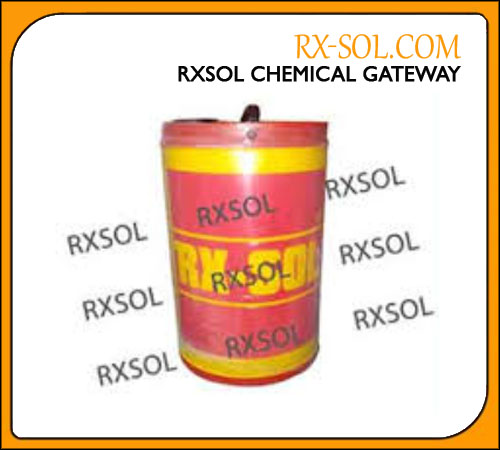
BACTI BARRIER DETERGENT/DISINFECTANT
Part No: RXSOL-41-8722-025
RXSOL ORG VI 28 Vanadium Inhibitor is used in blending crude and heavy oils with high concentrations of ash and corrosives that leads to encrustation and fouling.
RXSOL ORG VI 28 Vanadium Inhibitor is used in blending crude and heavy oils with high concentrations of ash and corrosives that leads to encrustation and fouling. It prevents vanadium build-up, protects against corrosion and deposit in the turbine that significantly improved gas turbine performance and efficiency.The Product is a superior Vanadium Corrosion Inhibitor and is recommended for use in the Boilers, Gas Turbines and Industrial Furnaces that burns Fuel Oil with high Vanadium and Sulphur contents to prevent Hot - end and Cold- end Corrosion.
Application
- Vanadium Inhibitor for Gas Turbine Power Plant operation on Crude Oil
- RXSOL ORG VI 28 is based on magnesium Polymerised and can be used in conjunction with other crude- or fueloil treatment.
Dosage
Technical Specification
PROPERTIES
|
Parameters |
Values | |
| Magnesium, wt% | : | 28-30 |
| Specific Gravity | : | 1.3 - 1.45 |
|
Viscosity @20°C, cSt |
: |
1300 max or suitable for injection pump |
| Na + K, ppm | : |
<2000 |
| Ca, ppm | : | 10000 |
| V+Pb, ppm | : | 20 -50 |
MSDS

| Product Name | Vanadium Inhibitor Polymerised |
| Part Number | RXSOL-81-1770-250 |
Company Details:
RX MARINE INTERNATIONAL
105, A wing , BSEL , TECH PARK.
VASHI ,NEW BOMBAY 400703 INDIA
Branch : Kandla. Mumbai, Chennai, Vizag, Kolkata, UAE & OMAN
| Phone | +91 22 20871200 - 1400 |
| Fax | +91 22 27612100 :::AOH :0091 9821214367 |
| 123 @ rxmarine.com | |
| Website | www.rxmarine.com |

| Name of Substance | Cas Number | Weight % |
| Magnesium Oxide | 1309-48-4 | 30 - 60 |
| Magnesium carboxylates | Trade secret. | 10 - 30 |
| Hydrotreated Naphthenic Distillates | 64742-52-5 | 10 - 30 |
| Heavy Aromatic Naphtha | 64742-94-5 | 10 - 30 |
| Asphalt | 8052-42-4 | 1 - 5 |
| Naphthalene | 91-20-3 | 1 - 5 |

| Physical State | Liquid |
| Odour | Aromatic Hydrocarbon |
| Colour | Dark Brown |
| OSHA/HCS status | This material is considered hazardous by the OSHA Hazard Communication Standard(29 CFR 1910.1200). |
| Emergency overview |
Warning. |

| Eye Contact | Get medical attention immediately. Immediately flush eyes with plenty of water for at. least 15 minutes, occasionally lifting the upper and lower eyelids. |
| Skin Contact | In case of contact, immediately flush skin with plenty of water for at least 15 minutes.while removing contaminated clothing and shoes. Wash clothing before reuse. Clean shoes thoroughly before reuse. Get medical attention immediately. |
| Inhalation: | Move exposed person to fresh air. If not breathing, if breathing is irregular or if respiratory arrest occurs, provide artificial respiration or oxygen by trained personnel. Loosen tight clothing such as a collar, tie, belt or waistband. Get medical attention immediately. |
| Ingestion |
Wash out mouth with water. Do not induce vomiting unless directed to do so by medical personnel. Never give anything by mouth to an unconscious person. Get medical attention immediately. |
| Protection of first-aiders | No action shall be taken involving any personal risk or without suitable training. If it is suspected that fumes are still present, the rescuer should wear an appropriate mask or self-contained breathing apparatus. It may be dangerous to the person providing aid to give mouth-to-mouth resuscitation. Wear suitable protective clothing and gloves. Remove contaminated clothing and shoes. |
| Additional information | If product is ingested and vomiting occurs naturally, have person lean forward to reduce the risk of aspiration into the lungs. |

| Flammability of the Product | Combustible liquid. In a fire or if heated, a pressure increase will occur and the container may burst, with the risk of a subsequent explosion. The vapor/gas is heavier than air and will spread along the ground. Vapors may accumulate in low or confined areas or travel a considerable distance to a source of ignition and flash back. |
| Suitable extinguishing media | Use dry chemical, CO2, water spray (fog) or foam. |
| Unsuitable extinguishing media | Do not use a solid water stream or jet |
|
Hazardous thermal decomposition products |
Carbon Dioxide,Carbon monoxide,metal Oxide/oxides |
|
Special protective equipment for fire-fighters |
Fire-fighters should wear appropriate protective equipment and self-contained breathing apparatus (SCBA) with a full face-piece operated in positive pressure mode. |

| Personal Protection | No action shall be taken involving any personal risk or without suitable training.Evacuate surrounding areas. Keep unnecessary and unprotected personnel from entering. Do not touch or walk through spilled material. Shut off all ignition sources. No flares, smoking or flames in hazard area. Do not breathe vapor or mist. Provide adequate ventilation. Wear appropriate respirator when ventilation is inadequate. Put on appropriate personal protective equipment (see Section 8). |
| Environmental precautions | Avoid dispersal of spilled material and runoff and contact with soil, waterways, drains and sewers. |
| Small spill | Stop leak if without risk. Move containers from spill area. Absorb with an inert material. Use spark-proof tools and explosion-proof equipment. Dispose of via a licensed waste disposal contractor. |
| Large spill | Stop leak if without risk. Move containers from spill area. Approach release from upwind. Dike spill area and do not allow product to reach sewage system or surface or ground water. Notify any reportable spill to authorities. (See section 12 for environmental risks and 13 for disposal information.) Contain and collect spillage with noncombustible, absorbent material e.g. sand, earth, vermiculite or diatomaceous earth and place in container for disposal according to local regulations (see section 13). Use spark-proof tools and explosion-proof equipment. Dispose of via a licensed waste disposal contractor. Contaminated absorbent material may pose the same hazard as the spilled product. Note: see section 1 for emergency contact information and section 13 for waste disposal. |

| Handling | Put on appropriate personal protective equipment (see Section 8). Eating, drinking and smoking should be prohibited in areas where this material is handled, stored and processed. Workers should wash hands and face before eating, drinking and smoking. Do not get in eyes or on skin or clothing. Do not breathe vapor or mist. Do not ingest. Use only with adequate ventilation. Store and use away from heat, sparks, open flame or any other ignition source. Use explosion-proof electrical (ventilating, lighting and material handling) equipment. Use non-sparking tools. Take precautionary measures against electrostatic discharges. To avoid fire or explosion, dissipate static electricity during transfer by grounding and bonding containers and equipment before transferring material. Empty containers retain product residue and can be hazardous. Do not reuse container. |
| Storage | Store in accordance with local regulations. Store in a segregated and approved area. Store in a dry, cool and well-ventilated area, away from incompatible materials (see Section 10). Eliminate all ignition sources. Separate from oxidizing materials. Keep container tightly closed and sealed until ready for use. Containers that have been opened must be carefully resealed and kept upright to prevent leakage. Do not store in unlabeled containers. Use appropriate containment to avoid environmental contamination. |
| Hygiene measures | Immediately change contaminated clothing. Apply preventive skin protection. Wash hands and face after working with substance. |

| Occupational exposure limits | TWA (8 hours) | STEL (15 mins) | Ceiling | ||||||||
| Ingredients: | List name | ppm | mg/m³ | Other | ppm | mg/m³ | Other | ppm | mg/m³ | other | Notations |
|
Magnesium oxide |
USACGIH OSHAPEL OSHAPEL 1989 USACGIH OSHAPEL USACGIH USACGIH OSHAPEL OSHAPEL 1989 |
-- |
10 |
-- -- -- -- -- -- -- -- |
-- |
-- -- -- -- -- -- 79 -- 75 |
-- -- -- -- -- -- -- -- |
-- -- -- -- -- -- -- -- |
-- -- -- -- -- -- -- -- |
-- -- -- -- -- -- -- -- |
(a) (b) (b) (a) (C) |
| Form |
[a]Inhalable fraction [b]Total particulates [c]Inhalable fraction. See Appendix C, paragraph A. Inhalable Particulate. Mass TLVs (IPM–TLVs) for those materials that are hazardous when deposited anywhere in the respiratory tract.
Consult local authorities for acceptable exposure limits. |
|
Recommended monitoring procedures |
If this product contains ingredients with exposure limits, personal, workplace atmosphere or biological monitoring may be required to determine the effectiveness of the ventilation or other control measures and/or the necessity to use respiratory protective equipment. |
| Engineering measures | Use only with adequate ventilation. Use process enclosures, local exhaust ventilation or other engineering controls to keep worker exposure to airborne contaminants below any recommended or statutory limits. Use explosion-proof ventilation equipment. |
| Hygiene measures | Wash hands, forearms and face thoroughly after handling chemical products, before eating, smoking and using the lavatory and at the end of the working period. Ensure that eyewash stations and safety showers are close to the workstation location. Take off contaminated clothing and wash before reuse. |
| Personal protection | |
| Respiratory | If a risk assessment indicates it is necessary, use a properly fitted, air purifying or supplied air respirator complying with an approved standard. Respirator selection must be based on known or anticipated exposure levels, the hazards of the product and the safe working limits of the selected respirator. |
| Hands | Chemical-resistant gloves: Nitrile or Neoprene gloves. 4H gloves. |
| Eyes | Wear chemical safety goggles. When transferring material wear face-shield in addition to chemical safety goggles. |


Gloves Suit

| Physical state | Liquid |
| Flash point | Closed cup: 67.2°C (153°F) [SFCC] |
| Auto-ignition temperature | Not available. |
| Flammable limits | Not available |
| Color | Brown. [Dark] |
| Odor | Brown. [Dark] |
| pH | 9.4 |
| 5% of product in 75% water / 25% isopropanol solution | |
| Boiling/condensation point | Not available. |
| Initial Boiling Point | : 178°C (352.4°F) |
| Melting/freezing point | Not available |
| Relative density | 1.31 (15.6°C) |
| Density | 10.91 (lbs/gal) |
| Vapor density | >1 [Air = 1] |
| Odor threshold | Not available. |
| Evaporation rate | Not available |
| VOC | 301 g/l |
| Viscosity | Dynamic (15.6°C): 64 cP |
| Solubility (Water) | Insoluble |
| Vapor pressure | Not available |
| Pour Point | -42.8°C (-45°F) |
| Partition coefficient : (LogKow) | Not available. |

| Chemical stability | The product is stable. |
| Possibility of hazardous reactions | Under normal conditions of storage and use, hazardous reactions will not occur. |
| Conditions to avoid | Avoid all possible sources of ignition (spark or flame). Do not pressurize, cut, weld, braze, solder, drill, grind or expose containers to heat or sources of ignition. Do not allow vapor to accumulate in low or confined areas. |
| Incompatible materials | Reactive or incompatible with the following materials: oxidizing materials. |
| Hazardous Decomposition Products | Under normal conditions of storage and use, hazardous decomposition products should not be produced. |
| Hazardous Polymerization | Under normal conditions of storage and use, hazardous polymerization will not occur. |

| Carcinogenicity Classification |
| Product/ingredient name | ACGIH | IARC | EPA | NIOSH | NTP | OSHA |
| Magnesium oxide | A4 | - | - | - | - | - |
| Hydrotreated naphthenic distillates | A4 | - | - | - | - | - |
| Asphalt | A4 | 3 | - | + | - | - |
| Naphthalene | A4 | 2B | - | - | Possible | - |
| Chronic toxicity Remarks | |
| Magnesium oxide | Magnesium oxide is a component of this product. Metal fume fever has been reproduced in rats; the no-effect level with chronic exposures up to 120 days was at least 1 mg/m³ (Pazynic and Cincevic, 1983; Pazynic, et al, 1984). |
| Magnesium carboxylates | Not available. |
| Hydrotreated naphthenic distillates | Distillates, petroleum, hydrotreated heavy naphthenic is a component of this product. Mice exposed dermally to 398 - 480 g/kg of mildly hydrotreated heavy naphthenic mineral oil, petroleum distillates for 22W - 80W developed tumors at the site of application. The severely treated product is classified by IARC as a Group 3, Animal Inadequate Evidence. |
| Heavy aromatic naphtha | Not available. |
| Asphalt |
Asphalt is a component of this product. Chronic effects seem to result from inhalation of asphalt fumes. |
|
Naphthalen |
This product contains naphthalene. A National Toxicology Program (NTP) report concluded there is clear evidence to support carcinogenicity of naphthalene in male and female rats. These observations were based on 2-year inhalation studies in which the test animals were exposed to 10, 30, and 60 ppm naphthalene. In male and female rats, exposure to naphthalene caused significant increases in the incidence of nonneoplastic lesions of the nose (NTP TR-500). The relevance of the rodent findings to humans is questionable. Naphthalene has caused hemolytic anemia, jaundice, cataracts (Shopp et al, 1984), allergic reactions (Tsyrkunov & Yakovleva, 1985), possible neurotoxicity (Riala et al, 1984), and aplastic anemia (Harden & Baetjer, 1978) in humans. Increased lung aveolar adenomas were seen in mice exposed to 30 ppm naphthalene for 6hrs/day for 6 months (ACGIH, 1992). Naphthalene crosses the placenta leading to methemoglobinemia (decreased ability for the blood to carry oxygen), and/or hemolytic anemia, conditions considered especially dangerous to the unborn (Reprotext). Liver and kidney damage has also been seen with exposure to naphthalene (Reprotext). Peripheral lens opacities occurred in 8 of 21 workers exposed to high levels of naphthalene fumes or vapors for 5 years, but cataracts have not been reported in other occupational studies. (Hathaway et al, 1991). The International Agency for Research on Cancer (IARC) evaluated naphthalene and concluded that there was sufficient evidence for carcinogenicity in experimental animals, but inadequate evidence that it causes cancer in exposed humans. Accordingly, IARC classified naphthalene as a possible human carcinogen (Group 2B). |

| Aquatic ecotoxicity |
| Product/ingredient name | Result | Species | Exposure |
| Naphthalene | Acute EC50 1.96 mg/L Fresh Water |
Daphnia - Water flea - Daphnia magna - <24 hours |
48 Hours |
|
Acute LC50 2350 ug/L Marine water |
Crustaceans - Daggerblade grass shrimp - Palaemonetes pugio |
48 Hours | |
| Acute LC50 213 ug/L Fresh water |
Fish - Crimson-spotted rainbowfish - Melanotaenia fluviatilis - Larvae - 1 days |
96 Hours | |
| Conclusion/Summary | Not available. | ||
| Biodegradability | |||
| Conclusion/Summary | Not available. | ||

| Waste treatment Method | The generation of waste should be avoided or minimized wherever possible. Empty containers or liners may retain some product residues. This material and its container must be disposed of in a safe way. Dispose of surplus and non-recyclable products via a licensed waste disposal contractor. Disposal of this product, solutions and any byproducts should at all times comply with the requirements of environmental protection and waste disposal legislation and any regional local authority requirements. Avoid dispersal of spilled material and runoff and contact with soil, waterways, drains and sewers. |
| Disposal should be in accordance with applicable regional, national and local laws and regulations.: Refer to Section 7: HANDLING AND STORAGE and Section 8: EXPOSURE CONTROLS/PERSONAL PROTECTION for additional handling information and protection of employees. |

|
Regulatory information |
UN number |
Proper shipping name |
Classes | PG* | Label |
Additional information |
| DOT Classification | NA1993 |
Combustible liquid, n.o.s. (Contains: Heavy aromatic naphtha) |
Combustible liquid. |
III |
Remarks This material is not regulated by DOT if transported in a packaging 119 gallons. This material is not regulated by TDG or IMO. |
|
| TDG Classification |
Not - regulated. |
- | - | - | - | |
|
IMDG Class - - - |
Not - regulated. |
- | - | - | - | |
|
IATA-DGR Class - - |
Not - regulated |
- | - | - | - | - |
| PG* | Packing group | |||||
|
DOT Reportable Quantity |
Naphthalene, 386 gal of this product. | |||||
| Marine pollutant | Not applicable | |||||
| North-America | NAERG : 128 | |||||

| HCS Classification |
Combustible liquid Irritating material Carcinogen Target organ effects |
| U.S. Federal regulations |
United States inventory (TSCA 8b): All components are listed or exempted. TSCA 12(b) one-time export: Naphthalene Clean Water Act (CWA) 307: Naphthalene Clean Water Act (CWA) 311: Naphthalene Clean Air Act (CAA) 112 regulated flammable substances: No products were found. Clean Air Act (CAA) 112 regulated toxic substances: No products were found. SARA 302/304/311/312 extremely hazardous substances: No products were found. SARA 302/304 emergency planning and notification: No products were found. SARA 302/304/311/312 hazardous chemicals: Magnesium oxide; Asphalt; Naphthalene SARA 311/312 MSDS distribution - chemical inventory - hazard identification: KI- 85X CORROSION INHIBITOR: Fire hazard, Immediate (acute) health hazard, |
| WHMIS (Canada) |
Class B-3: Combustible liquid with a flash point between 37.8°C (100°F) and 93.3°C(200°F). Class D-2A: Material causing other toxic effects (Very toxic). Class D-2B: Material causing other toxic effects (Toxic). |
| DSCL (EEC) | All components are listed or exempted.. |
| HMIS | |
| Health Hazard | : 2 |
| Fire Hazard | : 2 |
| Reactivity | : 0 |
| Personal Protection | : H |
| Fire : | |
| Health Hazard | : 2 |
| Fire Hazard | : 2 |
| Reactivity | : 0 |
| Specific Hazard | : .. |

| Other Information |
The information above is believed to be accurate and represents the best information currently available to us. However, we make no warranty of merchantability or any other warranty, express or implied, with respect to such information, and we assume no liability resulting from its use. Users should make their own investigations to determine the suitability of the information for their particular purposes. In no event shall be liable for any claims, losses, or damages of any third party or for lost profits or any special, indirect, incidental, consequential or exemplary damages, howsoever arising, even if Rx Marine International has been advised of the possibility of such damages. DISCLAIMER OF LIABILITY :The information in this SDS was obtained from sources which we believe are reliable. However, the information is provided without any warranty, express or implied, regarding its correctness. The conditions or methods of handling, storage, use or disposal of the product are beyond our control and may be beyond our knowledge. For this and other reasons, we do not assume responsibility and expressly disclaim liability for loss, damage or expense arising out of or in any way connected with the handling, storage, use or disposal of the product. This MSDS was prepared and is to be used only for this product. If the product is used as a component in another product, this MSDS information may not be applicable. |