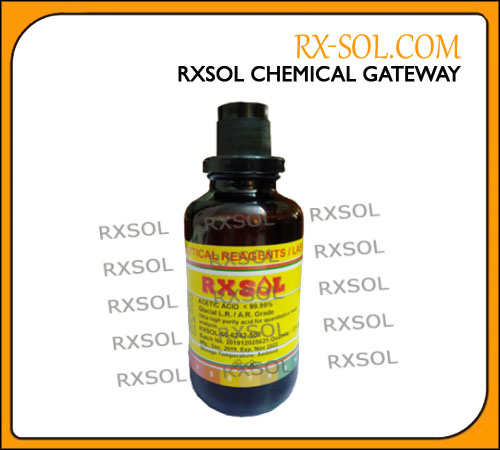
Methyl Red ACS
Part No: RXSOL-19-1490-500
We supply both Neutral & Alkaline sodium silicate absolute transparent quality i.e. water white.
Sodium silicate, also called water glass or Soluble Glass, is any one of several compounds containing sodium oxide, Na2O, and silica, Si2O, or a mixture of sodium silicates varying ratios of SiO2 to Na2O, solids contents, and viscosity. Traditionally, sodium silicates are classified according to the acid from which they are derived as Orthosilicate Na4SiO4; Metasilicate Na2SiO3; Disilicate Na2Si2O5; Tetrasilicate Na2Si4O9. They are also classified by an X-ray diffraction method according to their crystalline structure. All these compounds are colorless, transparent, glasslike substance available commercially as a powder or as a transparent, viscous solution in water. They can be dissolved in water to form a syrupy liquid. Some forms are slightly soluble, and some are almost insoluble; they are best dissolved by heating with water under pressure. The solutions are strongly alkaline. They are produced chiefly by fusing sand and sodium carbonate in various proportions. The use of sodium silicates is as a raw material for making silica gel. Also used in detergent; as a cement for glass, pottery, and stoneware; for fireproofing paper, wood, cement, and other substances; for fixing pigments in paintings and cloth printing.
Our Specialty:
We supply both Neutral & Alkaline sodium silicate absolute transparent quality i.e. water white.
Application
Silica gel production
Builder or anti-soil-redeposition agent for detergent
Peroxide stabilizer in bleaching for textile and pulp
Solubilizer in ink, flux binder for welding rods
Deflocculant for ceramic
Buffer
Fireproofing paper catalysts
Water treatment
Concrete hardner and acid-proof
Petroleum processing by emulsion breaking and corrosion prevention
Timber treatment.
Oil Field use
Sodium Silicate liquid both Neutral & Alkaline
We manufacture large range of Sodium Silicate both in Neutral and Alkaline grade of the typical qualities.
We also manufacture Sodium Silicate as per the customer's requirements and specification.
| Sodium Silicates | Concentration | Mole Ratio | Baume |
| Alkaline Sil | 40 - 54 % | 2.1 to 2.6 | 45 - 57 |
| Neutral Sil | 27 - 39 % | 3.0 to 3.5 | 30 - 41.5 |
- Surface hardness
- Abrasion resistance
- Overall structural integrity
- Basements and foundations
- Water tanks and reservoirs
- Tunnels and underground structures
- This helps prevent water ingress and enhances long-term durability.
- Strengthen weak soil
- Reduce permeability
- Improve load-bearing capacity
- Cement-based products
- Tile adhesives
- Refractory materials
Dosage
|
Sodium Silicate is a compound mixture of sodium oxide i.e. Na2o with silica sand i.e. Sio2 with water. Sodium silicate is also called water glass. There are two process to manufacture liquid Sodium Silicate. To manufacture a lower ratio of Sodium Silicate by Hydrothermal process. Mixture at Na2Co3 (Soda Ash) with Sio2(Silica sand) in furnace fuses of more then 1100oC gives sodium silicate glass in lumps form which is easily dissolved in hot water.We manufacture large range of sodium silicates, as per the customer's specific requirements. |
Technical Specification
TESTING PROCEDURE :::
ANLYSIS PROCEDEURE OF SODIUM SILICATE : Take 5gm of sodium dilute it to 250ml in SMF with dist. Water , take 50 ml of the diluted solution add 2-4 drops of methyl red indicator. Then titrate it against IN {approx.} HCL Light Pink is the end point. Take this reading as “A” ml. To this solution add 5 gm of sodium fluoride dissolve properly add 6-7 drops of methyl red indicator titrate against IN HCL appearance of slight pink colour is the end point . Take this reading as “B” ml
CALCULATION For Na2O
“A”ml x 3.1 x normality of HCl = C%
Wt. Of sample
For Sio2
“B”ml x 15.02 x normality of HCl
Wt. Of sample X 10
Ratio of sodium silicate
% of SiO2 i.e D%
% of Na2o C%
Viscosity- AS PER IS 3944 B4 CUP
DETERMINATION OF IRON (as per Fe)
- Botanic Potassium Thiocynate ;- dissolve 1.0gm of potassium thiocynate in10ml of water. Add sufficient n-butano to makeup to 100ml. Shake vigorously until the solution is clear.
- Dilute H2SO4 :- approx.10%
- Standard Iron solution : weight 0.702gm of Ferrus Ammonium sulfate. Dissolve in 10ml dilute H2SO4 then make up 1000ml with water. Transfer 10 ml of this solution in 100ml M.Flask and make up 100ml with water. 1ml of this solution is equivalent to 0.01mg of iron
PRCEDURE :
- Sample Reading: take about 5gm of the sample accurately weighted. Dissolve it in distilled water and make the solution exactly 100ml. Take 10 ml of this solution add 1ml concentrated Nitric acid. Boil the solution and cool. Then transfer it into a nessler cylinder and add 30mg of Ammonium Persulfate and 15 ml of Botanic Potassium Thiocynate solution. Shake for 30 sec and allow the liquid to separate.
-
Blank reading : take 10 ml distilled water. Add 1ml concentrated Nitric acid boil the solution and cool. Then transfer it into a nesseler cylinder and add 30 mg of Ammonium Persulfate and 15 ml of Botanic Potassium Thiocynate solution . Shake for 30 sec. And allow the liquid to separate. Then add Standard Iron Solution until the colour of Butanol Layers in Both Cylinder (Sample & Blank)
CALCULATION :
Iron as Fe (%w) = 0.001 V
W
Where,
V= Volume in ml of Standard Iron Solution to add in Blank Reading
W= Weight in gm of sample
MSDS

| Product Name | RXSOL-81-8107-280 |
| Product Type | SODIUM SILICATE |
Company Details:
RX MARINE INTERNATIONAL
105, A wing , BSEL , TECH PARK.
VASHI ,NEW BOMBAY 400703 INDIA
| Phone | +91 22 65113333 / 5555 / 9999 / 27815540 |
| Fax | +91 22 2781 1318 :::AOH :0091 9821214367 |
| mail @ rxmarine.com |

|
Chemica Name |
CAS Number |
|
Sodium silicate |
1344-09-840 |
|
Water |
7732-18-5 |

Repeated or prolonged exposure to spray mist may produce respiratory tract irritation leading to frequent attacks of bronchial infection. Repeated or prolonged inhalation of vapors may lead to chronic respiratory irritation.

Eye Contact:
Check for and remove any contact lenses. Immediately flush eyes with running water for at least 15 minutes, keeping eyelids open. Cold water may be used. Do not use an eye ointment. Seek medical attention.
Skin Contact:
If the chemical got onto the clothed portion of the body, remove the contaminated clothes as quickly as possible, protecting your own hands and body. Place the victim under a deluge shower. If the chemical got on the victim's exposed skin, such as the hands : Gently and thoroughly wash the contaminated skin with running water and non-abrasive soap. Be particularly careful to clean folds, crevices, creases and groin. Cold water may be used. If irritation persists, seek medical attention. Wash contaminated clothing before reusing.
Serious Skin Contact:
Wash with a disinfectant soap and cover the contaminated skin with an anti-bacterial cream. Seek medical attention.
Inhalation:
Allow the victim to rest in a well ventilated area. Seek immediate medical attention.
Serious Inhalation:
Not available.
Ingestion:
Do not induce vomiting. Loosen tight clothing such as a collar, tie, belt or waistband. If the victim is not breathing, perform mouth-to-mouth resuscitation. Seek immediate medical attention.
Serious Ingestion:
Not available

|
Fire-fighting measures |
Not flammable. In case of fire use extinguishing media appropriate to surrounding conditions |

|
Personal Precautions |
Wear protective clothing as per section 8 |
|
Environmental Precautions |
No special precautions are required for this product Immediate Actions. Shut off source of leak if safe to do so |
|
Clean Up Actions |
Absorb spillage in inert material and shovel up. Flush spill area with copious amounts of water |

|
Handling |
The usual precautions for handling chemicals should be observed. Eyewash bottles should be available - See Section 8. |
|
Storage |
Keep only in the original container in a cool, well ventilated place . Protect from frost. |

|
Exposure Limits |
There are no recommended or established controls for this product. |
|
Exposure controls |
No special ventilation is required unless the product is used in a spray form. |
|
Occupational exposure controls |
Wear suitable protective clothing, including eye/face protection and gloves (plastic or rubber are recommended) No respiratory protection is required unless subject to contact with substance mist. |


Gloves Goggles Suit

|
Odour |
Characteristic odour |
|
Appearance |
Clear Colorless |
|
pH |
Alkaline |
|
Boiling point |
>100 °C at 760 mm / Hg |
|
Melting Point |
Not Available |
|
Vapour pressure |
not known |
|
Specific Gravity |
1.4 to 1.42 |
| Solublity in Water |
Soluble |

Stability : The product is stable.
Instability: Temperature: Not available.
Conditions of Instability:Not available.
Incompatibility with various substances: Highly reactive with acids. Reactive with oxidizing agents.
Corrosivity: Slightly corrosive to corrosive in presence of steel, of aluminum, of zinc, of copper. Non-corrosive in presence of glass.
Special Remarks on Reactivity:Not available.
Special Remarks on Corrosivity:Not available.
Polymerization:No

Routes of Entry: Eye contact. Inhalation. Ingestion.
Toxicity to Animals: LD50: Not available. LC50: Not available.
Chronic Effects on Humans:Not available.
Other Toxic Effects on Humans: skin contact (corrosive, irritant), of ingestion, of inhalation.
Special Remarks on Toxicity to Animals:Not available.
Special Remarks on Chronic Effects on Humans:Not available.
Special Remarks on other Toxic Effects on Humans:Not available.

Ecotoxicity: Not available.
BOD5 and COD:Not available.
Products of Biodegradation:Possibly hazardous short term degradation products are not likely. However, long term degradation products may arise.
Special Remarks on the Products of Biodegradation:Not available.

|
Disposal considerations |
Do not discharge into drains or the environment, dispose to an authorised waste collection point Disposal should be in accordance with local, state or national legislation |

- Not classified as hazardous for transport

Federal and State Regulations:
TSCA 8(b) inventory: Sodium silicate; Water
Other Regulations:
OSHA: Hazardous by definition of Hazard Communication Standard (29 CFR 1910.1200).
Other Classifications:
WHMIS (Canada): CLASS D-2B: Material causing other toxic effects (TOXIC).
DSCL (EEC): R35- Causes severe burns.
HMIS (U.S.A.):
Health Hazard:3
Fire Hazard:0
Reactivity:0
Personal Protection:
National Fire Protection Association (U.S.A.):
Health:3
Flammability:0
Reactivity:0
Specific hazard:
Protective Equipment:
Gloves. Full suit. Vapor respirator. Be sure to use an approved/certified respirator or equivalent. Wear appropriate respirator
when ventilation is inadequate. Face shield

.