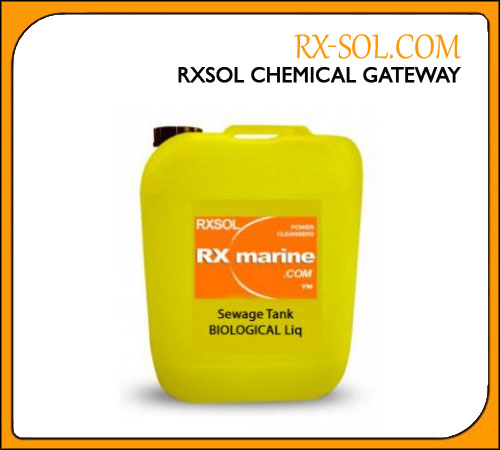
Sewage Tank BIOLOGICAL Liq
Part No: RXSOL-16-3009-010
This is a reverse osmosis membrane treatment chemicals . It is highly concentrated polymer chemicals.
This is a reverse osmosis membrane treatment chemicals . It is highly concentrated polymer chemicals. Antiscalant RXSOL-33-3302-230 is a liquid antiscalant designed to inhibit scale in cellulose acetate and polyamide membrane separation systems. The formulation contains a 35% by weight solution of poly acid that has a tight molecular weight range of 2000. This product is designed for use in waters that do not have a high potential for colloidal and silt fouling of RO membrane surfaces (i.e. groundwater applications). Antiscalant RXSOL-33-3302-230 can be injected neat or diluted and a site‐specific dosage can be determined using software program.
Application
Performance:
Antiscalant RXSOL-33-3302-230 offers a variety of critical performance and application benefits:
- Inhibits RO membrane scaling caused by the following:
| Calcium Carbonate: | CaCO3 |
| Calcium Sulfate: | CaSO4 |
| Barium Sulfate: | BaSO4 |
| Strontium Sulfate: | SrSO4 |
| Calcium Fluoride: | CaF2 |
- Compatible with the polyamide and cellulose acetate RO membranes of the leading manufacturers.
Dosage
Dosing Guidelines:
The typical dosage range is between 2 to 5 ppm or Typical dosage range is between 2 and 6 mg/L.. A site‐specific dose can be determined using computer program. Like any injected chemical, over or underdosing may cause unnecessary membrane system fouling. Please contact the Avista customer service department for customized dosing instructions.
Dilution:
This product is formulated to be injected neat. However, if a dilution is required, use demineralized or RO permeate water. If neither of these is available, softened water may be substituted. The dilution for Vitec 1000 should not result in a solution strength of less than 10%. This guidelin will protect the effectiveness of the internal bacteriostat which inhibits bacterial growth in the drum and feed tank.Maximum dilution is temperature related as shown below.
Temperature, °C Maximum Dilution, %
<30 12
30-35 25
>35 50
230 performance is achieved when the chemical is injected downstream of multimedia filters and upstream of cartridge filters. For maximum effectiveness, Antiscalant RXSOL-33-3302-230 should be added prior to the static mixer or cartridge filter housing. For potable the maximum dosage is 10 mg/L. Maximum dilution is 10% with RO permeate or DI water
Dosing Guidelines:
The typical dosage range is between 2 to 5 ppm or Typical dosage range is between 2 and 6 mg/L.. A site‐specific dose can be determined using computer program. Like any injected chemical, over or underdosing may cause unnecessary membrane system fouling. Please contact the Avista customer service department for customized dosing instructions.
Dilution:
This product is formulated to be injected neat. However, if a dilution is required, use demineralized or RO permeate water. If neither of these is available, softened water may be substituted. The dilution for Vitec 1000 should not result in a solution strength of less than 10%. This guidelin will protect the effectiveness of the internal bacteriostat which inhibits bacterial growth in the drum and feed tank.Maximum dilution is temperature related as shown below.
Temperature, °C Maximum Dilution, %
<30 12
30-35 25
>35 50
Packaging and Storage:
Standard regional pack sizes are listed below and custom packaging can be provided worldwide. This product should be protected from freezing.
| Specifications | |
| Appearance: | Yellow to liquid |
| pH (10% solution): | 2.9 |
|
Specific Gravity@20oC: |
1.67 - 1.2 |
Packing 30 Kgs, 230 Kgs drum.
MSDS

| Product Code | RXSOL-33-3302-230 |
| Product Name | ANTISCALANT |
Company Details:
RX MARINE INTERNATIONAL
105, A wing , BSEL , TECH PARK.
VASHI ,NEW BOMBAY 400703 INDIA
| Phone | +91 22 65113333 / 5555 / 9999 |
| Fax | +91 22 2781 1318 :::AOH :0091 9821214367 |
| mail @ rxmarine.com |

| INGREDIENTS | CAS no |
Concentration |
Exposure Limits / Health Hazards |
| Phosphonic acid, (1-hydroxyethylidene)bis-, disodium salt | 7414-83-7 | 10% | ND |
|
PHOSPHONIC ACID (1-HYDROXYETHYLIDENE)BIS |
2809-21-4 | 7- 13 % | ND |

| Skin contact |
May be irritating |
| Eye contact |
May be irritating |
|
Inhaled |
Breathing of the mists, vapors or fumes may irritate the nose, throat and lungs. Symptoms may include sore throat, coughing, labored breathing, sneezing and burning sensation, depending on the concentration and duration of exposure. Overexposure to this material may cause systemic damage including target organ effects listed under "Toxicological Information |

|
inhaled |
Remove to fresh air. If not breathing, institute rescue breathing. If breathing is difficult, ensure airway is clear and give oxygen |
|
skin contact |
Breathing of the mists, vapors or fumes may irritate the nose, throat and lungs. Symptoms may include sore throat, coughing, labored breathing, sneezing and burning sensation, depending on the concentration and duration of exposure. Overexposure to this material may cause systemic damage including target organ effects listed under "Toxicological Information |
|
eye contact |
Flush immediately with large amounts of water for at least 15 minutes. Eyelids should be held away from the eyeball to ensure thorough rinsing. GET IMMEDIATE MEDICAL ATTENTION |
|
Ingestion |
Keep affected person warm and at rest. GET IMMEDIATE MEDICAL ATTENTION. Never give anything by mouth to an unconscious person. Do not induce vomiting because of danger of aspirating liquid into lungs, causing serious damage and chemical pneumonitis |

|
EXTINGUISHING MEDIA |
Material itself will not burn |
|
BASIC FIRE FIGHTING PROCEDURES |
area and fight fire from a safe distance. Use extinguishing agent suitable for type of surrounding fire. Use water spray to cool adjacent structures and to protect personnel. Shut off source of flow if possible. Firefighters must wear MSHA/NIOSH approved positive pressure breathing apparatus (SCBA) with full face mask and full protective equipment |

|
emergency action |
Keep unnecessary people away. Isolate spill area and keep unnecessary people away |
|
environmental precautions |
If product is released to the environment, take immediate steps to stop and contain release. Caution should be exercised regarding personnel safety and exposure to the released product. Notify local, provincial and/or federal authorities, if required |
|
spill or leak procdure |
Large spills may be neutralized with dilute alkaline solutions of soda ash or lime. Stop leak when safe to do so. Do not touch or walk through spilled material. |

|
Precautions for safe handling |
This material should be stored and shipped in plastic or plastic lined containers. Do not use with materials or equipment sensitive to acidic solutions |
|
Conditions for safe storage, including any incompatibilities |
Avoid contact with strong oxidizers, bases, and metals. Store in tightly closed containers in cool, dry area away from heat and incompatibles |

|
engineering controls |
General or local exhaust ventilation and other forms of engineering controls are the preferred means for controlling exposures. |
|
Eye/face protection |
Wear chemical safety goggles to prevent eye contact. Have eye washing facilities readily available where eye contact can occur |
|
Skin protection |
Avoid skin contact with this material. If skin contact is anticipated, protective clothing, including impervious gloves, should be worn. Protective glove materials include, but are not limited to natural rubber, neoprene or nitrile. |

|
Appearance |
Yellow to Amber liquid |
|
Odour |
NA |
|
pH |
2.90 |
|
Melting point/freezing point |
-4 deegree |
|
Specific Gravity |
1.16 -1.2 |
|
Bulk Density |
NA |
|
Flah Point |
NA |
|
Water solubility |
Complete soluble |

STABILITY/INCOMPATIBILITY:- Incompatible with bases, and oxidizers. Avoid contact with metals. See precautions under
Handling & Storage

| skin contact |
may be irritating |
| eye contact |
may be irritating |
|
inhaled |
Breathing of the mists, vapors or fumes may irritate the nose, throat and lungs. Symptoms may include sore throat, coughing, labored breathing, sneezing and burning sensation, depending on the concentration and duration of exposure. Overexposure to this material may cause systemic damage including target organ effects listed under "Toxicological Information |

Not toxic to aquatic organisms and not suspected of long-term adverse effects in the aquatic environment

This product, in its present state, when discarded or disposed of, is not a hazardous waste

N/A

N/A

The above information is believed to be correct but does not purport to be all inclusive and shall be used only as a guide. The information in
this document is based on the present state of our knowledge and is applicable to the product with regard to appropriate safety precautions