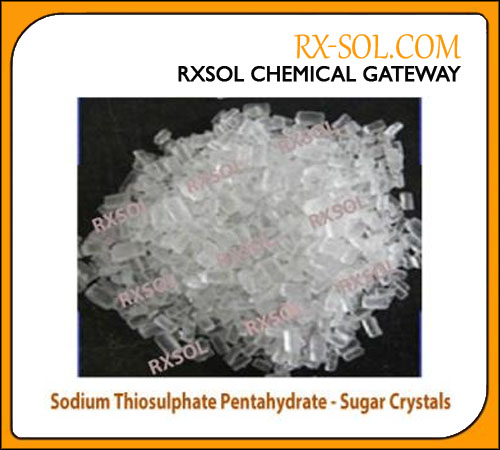
Sodium Thiosulphate Pentahydrate Sugar Crystals
Part No: RXSOL-37-2031-025
Sugar Crystals is a highly water-soluble inorganic chemical widely used as a reducing agent, dechlorinating agent, chemical neutralizer and fixing agent in industrial and water treatment applications.
RXSOL Technical Product Bulletin
Sodium Thiosulphate Pentahydrate – Sugar Crystals
Chemical Name: Sodium Thiosulphate Pentahydrate Common Names: Sodium Hyposulphite, Sodium Hypo, Hypo Crystals, Sodium Thiosulfate 5-Hydrate Chemical Formula: Na₂S₂O₃·5H₂O CAS Number: 10102-17-7 Molecular Weight: 248.18 g/mol Product Grade: Industrial / Technical Grade (other grades subject to specification) Physical Form: White to colourless, transparent crystalline granules resembling sugar crystals
Product Description
Sodium Thiosulphate Pentahydrate Sugar Crystals is a highly water-soluble inorganic chemical widely used as a reducing agent, dechlorinating agent, chemical neutralizer and fixing agent in industrial and water treatment applications.
The product consists of colourless to white crystalline particles with a sugar-like appearance. It is particularly effective for removing residual chlorine from water, neutralizing oxidizing agents and supporting various chemical processing operations.
Sodium Thiosulphate Pentahydrate is extensively used in water treatment plants, swimming pool maintenance, textile processing, photographic processing, pulp and paper industries, chemical manufacturing and laboratory applications.
Sodium Thiosulphate Anhydrous manufacturer exporter, supplier. We also keeping Sodium Thiosulphate Anhydrous extrapure AR, 99.5%
Application
Applications:
-
Textile bleaching neutralization.
-
Removal of residual oxidizing chlorine.
-
Fabric processing.
-
Dyeing and finishing operations.
-
Protection of fibres from residual chlorine damage.
We process a white crystalline solid, sodium Thio sulphate anhydrous, which is widely used in chemicals and detergents. Our wide range of sodium Thio sulphate is made of qualitative ingredients to ensure safety and effective use at client's end. These are available with us at industry leading prices and are extensively used in industries.
Dosage
Recommended Dosage for Dechlorination
Theoretical sodium thiosulphate pentahydrate demand depends on the reaction products and operating conditions.
For a commonly used chlorine-to-chloride reaction producing tetrathionate:
[ 2Na_2S_2O_3 + Cl_2 \rightarrow Na_2S_4O_6 + 2NaCl \]
The theoretical requirement is approximately 7.0 mg of pure Sodium Thiosulphate Pentahydrate per 1 mg of chlorine expressed as Cl₂.
Further oxidation of thiosulphate to sulphate can result in a different stoichiometric requirement. Consequently, the actual operating dose must be established by testing.
|
Water Volume |
Initial Chlorine |
Theoretical Quantity* |
|---|---|---|
|
1,000 L |
1 ppm |
7 g |
|
10,000 L |
1 ppm |
70 g |
|
50,000 L |
1 ppm |
350 g |
|
100,000 L |
1 ppm |
700 g |
|
100,000 L |
5 ppm |
3.5 kg |
Based on 100% pure pentahydrate and the tetrathionate reaction. These are calculation examples, not universal operating dosages. Verify the required dose through controlled jar testing and residual chlorine measurements.
6. Preparation of Sodium Thiosulphate Solution
For preparing a 10% w/v solution:
-
Fill a clean chemical-resistant mixing vessel with approximately 70% of the required final volume of clean water.
-
Add 100 grams of Sodium Thiosulphate Pentahydrate for each litre of final solution.
-
Stir until all crystals dissolve.
-
Add water to reach the final required volume.
-
Store in a clean, labelled, tightly closed container.
-
Determine the dosing rate from actual chlorine demand and verify the residual chlorine after mixing.
Avoid contamination with acids and strong oxidizing chemicals.
Key Product Features and Advantages
-
High water solubility for rapid preparation of aqueous solutions.
-
Effective reducing agent for chlorine and selected oxidizing chemicals.
-
Convenient crystalline form for storage, weighing and handling.
-
Useful for residual chlorine neutralization in water treatment systems.
-
Suitable for textile processing and photographic fixing formulations.
-
Can be used in chemical manufacturing and analytical laboratories.
-
Available in crystalline form for industrial chemical processing.
-
Helps protect downstream dechlorination-sensitive processes when properly dosed.
Technical Specification
Typical Technical Specifications
|
Parameter |
Typical Specification |
|---|---|
|
Product Name |
Sodium Thiosulphate Pentahydrate |
|
Chemical Formula |
Na₂S₂O₃·5H₂O |
|
CAS Number |
10102-17-7 |
|
Molecular Weight |
248.18 g/mol |
|
Appearance |
Clear to white crystalline solid |
|
Crystal Form |
Sugar-like crystals / granules |
|
Assay (Na₂S₂O₃·5H₂O) |
≥ 99.0% (typical high-purity grade) |
|
Solubility in Water |
Approximately 70 g/100 mL at 20°C |
|
pH (5% Aqueous Solution) |
Approximately 6.0–8.5 |
|
Specific Gravity (Solid) |
Approximately 1.67 |
|
Melting Behaviour |
Melts in its water of crystallization around 48°C |
|
Odour |
Odourless |
|
Sodium Sulphite |
Grade-dependent |
|
Water-Insoluble Matter |
Grade-dependent |
|
Iron (Fe) |
Grade-dependent |
|
Heavy Metals |
Grade-dependent |
|
Storage |
Cool, dry, tightly closed containers |
|
Shelf Life |
Subject to manufacturer stability data and storage conditions |
Note: These are indicative technical values and proposed grade requirements, not certified RXSOL batch results. Final specifications should be confirmed against the approved product specification and Certificate of Analysis.
| Specifications |
Extra Pure |
Industrial |
| Formula | Na2S2O3.5H2O | Na2S2O3.5H2O |
| CAS | 10102-17-7 | 10102-17-7 |
| Molecular Weight | 248.17 | 248.17 |
| Physical Appearance | Snow White Crystalline Material | White Crystalline Material |
| Assay (Min.) | 99% | 98% |
| Loss on Drying (LOD) | 1% Max. | 2% Max. |
| pH of 10% Solution | 6.5 - 8.5 | 6.5 - 8.5 |
MSDS

| Product Name |
Sodium Thiosulfate Pentahydrate |
| Part Number | RXSOL-42-2031-025 |
Company Details:
RX MARINE INTERNATIONAL
105, A wing , BSEL , TECH PARK.
VASHI ,NEW BOMBAY 400703 INDIA
Stock Point : Mumbai, Kandla, Kolkata, Chennai, Visakhapatnam, Fujairah, Muscat, Nairobi Kenya, Canada
| Phone | +91 22 27815540 / 41 / 42 |
| Fax | +91 22 2781 1318 :::AOH :0091 9821214367 |
| mail @ rxmarine.com | |
| Website | www.rxmarine.com |
Synonym: Ametox, Antichlor; Sodium Hyposulfite, Pentahydrate
Chemical Name: Thiosulfuric Acid, disodium salt, Pentahydrate
Chemical Formula: Na2S2O3.5H20

| Component | CAS-No | Weight % |
| Sodium Thiosulfate Pentahydrate | 10102-17-7 | 99 % |

| Signal Word | : | Irritant |
| Potential Acute Health Effects: | : | Hazardous in case of ingestion, of inhalation. Slightly hazardous in case of skin contact (irritant), of eye contact (irritant). |
| Potential Chronic Health Effects: | : | Slightly hazardous in case of skin contact (irritant, sensitizer). CARCINOGENIC EFFECTS: Not available. MUTAGENIC EFFECTS: Not available. TERATOGENIC EFFECTS: Not available. DEVELOPMENTAL TOXICITY: Not available. |

| Eye Contact : |
Check for and remove any contact lenses. In case of contact, immediately flush eyes with plenty of water for at least 15 minutes. Cold water may be used. Get medical attention if irritation occurs. |
| Skin Contact: | Wash with soap and water. Cover the irritated skin with an emollient. Get medical attention if irritation develops. Cold water may be used. |
| Serious Skin Contact: | Not available |
| Inhalation: |
If inhaled, remove to fresh air. If not breathing, give artificial respiration. If breathing is difficult, give oxygen. Get medical attention. |
| Serious Inhalation: | Not available. |
| Ingestion: | Do NOT induce vomiting unless directed to do so by medical personnel. Never give anything by mouth to an unconscious person. If large quantities of this material are swallowed, call a physician immediately. Loosen tight clothing such as a collar, tie, belt or waistband.. |
| Serious Ingestion | Not available. |

Flammability of the Product: Non-flammable.
Auto-Ignition Temperature: Not applicable.
Flash Points: Not applicable.
Flammable Limits: Not applicable.
Products of Combustion: Not available.
Fire Hazards in Presence of Various Substances: Not applicable.
Explosion Hazards in Presence of Various Substances:
Risks of explosion of the product in presence of mechanical impact: Not available.
Risks of explosion of the product in presence of static discharge: Not available.
Fire Fighting Media and Instructions: Not applicable.
Special Remarks on Fire Hazards: When heated to decomposition it emits toxic fumes of sulfur oxides, hydrogen sulfide, and sodium oxide.
Special Remarks on Explosion Hazards: An explosion may occur if triturated with nitrates, chlorates, or permanganates.

Small Spill:
Use appropriate tools to put the spilled solid in a convenient waste disposal container. Finish cleaning by spreading water on the
contaminated surface and dispose of according to local and regional authority requirements.
Large Spill:
Use a shovel to put the material into a convenient waste disposal container. Finish cleaning by spreading water on the contaminated
surface and allow to evacuate through the sanitary system

Precautions:
Do not breathe dust. Wear suitable protective clothing. In case of insufficient ventilation, wear suitable respiratory equipment.
If you feel unwell, seek medical attention and show the label when possible. Keep away from incompatibles such as oxidizing
agents, acids, alkalis.
Storage: Hygroscopic. Keep container tightly closed. Keep container in a cool, well-ventilated area.

Engineering Controls:
Use process enclosures, local exhaust ventilation, or other engineering controls to keep airborne levels below recommended
exposure limits. If user operations generate dust , fume or mist, use ventilation to keep exposure to airborne contaminants
below the exposure limit.
Personal Protection:
Safety glasses. Lab coat. Dust respirator. Be sure to use an approved/certified respirator or equivalent. Gloves.
Personal Protection in Case of a Large Spill:
Splash goggles. Full suit. Dust respirator. Boots. Gloves. A self contained breathing apparatus should be used to avoid
inhalation of the product. Suggested protective clothing might not be sufficient; consult a specialist BEFORE handling this product.
Exposure Limits: Not available.


Gloves Suit

| Physical State | : | Solid |
| Colour & Appearance | : | White Powder/Granular |
| Odour | : | Odourless |
| Taste | : | Saline |
| Molecular Weight | : | 248.19 g/mole |
| PH | : | 5% solution: 6.0-8.4 |
| Boiling Point/Range | : | >100°C (212°F) |
| Melting / Freezing Point | : | 48°C (118.4°F) |
| Critical Temperature | : | Not available. |
| Specific Gravity | : | 1.7 - 1.75(Water = 1). |
| Vapor Pressure | : | Not Applicable |
| Vapor Density | Not available. | |
| Volatility Density | : | Not Available |
| Odor Threshold | : | Not Available |
| Water/Oil Dist. Coeff | : | Not Available |
| Partition coefficient n octanol/water | : | Not available. |
| Ionicity (in Water) | : | Not available |
| Dispersion Properties | : | See solubility in water |
| Solubility | : | Soluble in cold water, hot water. Solubility in water: 79 g/100 ml @ 4 deg. C (39 deg. F) 680 g/liter @ 20 deg. C |

| Stability | : | The product is stable. |
| Instability Temperature | : | Not available. |
| Conditions of Instability | : | Incompatible materials,Moisture |
| Incompatibility with various substances | : | Reactive with oxidizing agents, acids, alkalis. |
| Corrosivity | Non-corrosive in presence of glass. | |
| Special Remarks on Reactivity | It is a strong reducing and can react with oxidizers. Reacts with acids to release sulfur dioxide. Sodium Thiosulfate pentahydrate dissolves in its own water of hydation; it effloresces in warm dry air. Sodium Thiosulfate pentahydrate loses water at 100 deg. C. It is incompatible with iodine, acids, lead, mercury, and silver salts (e.g. silver nitrate), halogens. Hygroscopic; keep container tightly closed. Protect from moisture | |
| Special Remarks on Corrosivity |
Not Available |
|
| Polymerization | Will not occur. |

| Routes of Entry | Inhalation. Ingestion. | |
| Toxicity to Animals | LD50: Not available. LC50: Not available | |
| Chronic Effects on Humans | Not available | |
| Other Toxic Effects on Humans | Hazardous in case of ingestion, of inhalation. Slightly hazardous in case of skin contact (irritant). | |
| Special Remarks on Toxicity to Animals |
Not available. |
|
| Special Remarks on Chronic Effects on Humans | Not available | |
| Special Remarks on other Toxic Effects on Humans | Acute Potenial Health Effects: Skin: It may cause mild skin irritation. Eyes: Can cause mechanical eye irritation. Inhalation: May cause upper respiratory tract and mucous membrane irritation. Ingestion: Sodium Thiosulfate is an agent with a low order of toxicity. Ingestion of large doses may cause gastrointestinal irritation disturbances with nausea, vomiting, addominal cramping, diarrhea, metabolic acidosis, and hypernatremia. May also affect respiration (cyanosis, respiratory stimulation), cardiovascular(hypotension), behavior (ataxia, convulsions) Chronic Potential Health Effects: Skin: Prolonged or repeated skin contact may allergic dermatitis, and irritation. The toxicological preperties of this substance have not been fully investigated |

| Ecotoxicity: | Not available. |
| BOD5 and COD: | Not available. |
| Products of Biodegradation : | Possibly hazardous short term degradation products are not likely. However, long term degradation products may arise. |
| Toxicity of the Products of Biodegradation: | The product itself and its products of degradation are not toxic. |
| Special Remarks on the Products of Biodegradation: | Not available. |

Waste Disposal: Waste must be disposed of in accordance with federal, state and local environmental control regulations

DOT Classification: Not a DOT controlled material (United States).
Identification: Not applicable.
Special Provisions for Transport: Not applicable.

Federal and State Regulations: No products were found.
Other Regulations: Not available.
Other Classifications:
WHMIS (Canada): Not controlled under WHMIS (Canada).
DSCL (EEC):
This product is not classified according to the EU regulations. S24/25- Avoid contact with skin and eyes. S28- After contact
with skin, wash immediately with plenty of water. S37- Wear suitable gloves. S45- In case of accident or if you feel unwell,
seek medical advice immediately (show the label where possible).
HMIS (U.S.A.):
Health Hazard: 2
Fire Hazard: 0
Reactivity: 0
Personal Protection: E
National Fire Protection Association (U.S.A.):
Health: 2
Flammability: 0
Reactivity: 0
Specific hazard:
Protective Equipment:
Gloves. Lab coat. Dust respirator. Be sure to use an approved/certified respirator or equivalent. Splash goggles.

The information above is believed to be accurate and represents the best information currently available to us. However, we make no
warranty of merchantability or any other warranty, express or implied, with respect to such information, and we assume no liability resulting
from its use. Users should make their own investigations to determine the suitability of the information for their particular purposes. In no
event shall be liable for any claims, losses, or damages of any third party or for lost profits or any special, indirect, incidental, consequential
or exemplary damages, howsoever arising, even if Rx Marine International has been advised of the possibility of such damages.
DISCLAIMER OF LIABILITY :The information in this SDS was obtained from sources which we believe are reliable. However, the information is provided without any warranty, express or implied, regarding its correctness. The conditions or methods of handling, storage, use or disposal of the product are beyond our control and may be beyond our knowledge. For this and other reasons, we do not assume responsibility and expressly disclaim liability for loss, damage or expense arising out of or in any way connected with the handling, storage, use or disposal of the product. This MSDS was prepared and is to be used only for this product. If the product is used as a component in another product, this MSDS information may not be applicable.