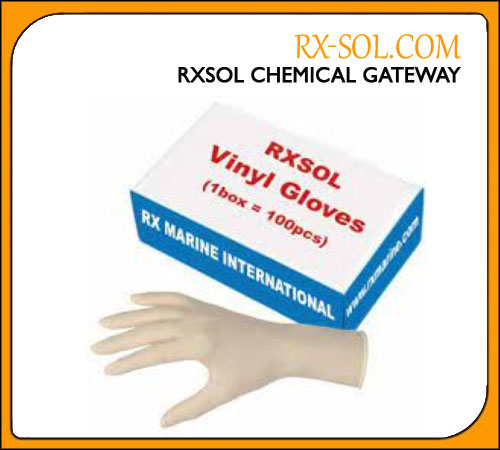
Vinyl Gloves (1box =100pcs)
Part No: RXSOL-21-2108-001
Applications for this Product : Cleaning · Personal Care · Plastics.
DIETHYL PHTHALATE DEP used as Cleaning agent also in Personal Care and in Plastics. DEP is used as solvent or vehicle for fragrances in Perfume, as a fixative for manufacturing Agarbatti, in the processing of Cellulose Acetate and as a plasticizer in Plastic Tools. Diethyl Phthalate is a nearly colorless, clear and practically anhydrous liquid with a hardly noticeable odour, which is soluble in most of organic solvents & insoluble in water.
Application
DHP commonly use as plasticizers. Also DIETHYL PHTHALATE DEP used in cosmetics and fragrances, and as detergent bases in aerosol sprays. In industries DHP Used in the manufacture of perfumes, plastics, mosquito repellents and many other products.
Plasticizers increases the plasticity or decrease the viscosity of a material.
Dosage
Diethyl Phthalate (DEP) used for different industries such as perfumery and cosmetics. We ensure high quality standards by consistently meeting all technical and quality specifications of Diethyl Phthalate required by various our customers.
Technical Specification
| PRODUCT NAME | : | DIETHYLPHTHALATE |
| CAS number | : | 84-66-2 |
| UN number | : | |
| Formula | : | C6H4(CO2C2H5)2 |
| Odour | : | ODOURLESS |
| Solubility in water | : | INSOLUBLE |
| Density | : | 1.12 at 25 oC |
| Boiling point DIN 53171 | : | 294-298°C |
| Melting point | : | -40oC |
| Pour Point, DIN ISO 3016 | ||
| Viscosity , ASTM D 445 | : | 10.16 CPS |
| Flashpoint | : | 150 oC |
| Acid Value ASTM D 1045 / D 1613 | 0.360 | |
| Explosive limits | : | |
| Retractive Index ASTM D 1807 | 1.501 | |
| Vapour pressure | : | 01 mbar at 20 oC |
| Skin absorption/irritation | : | YES |
| TLV Country NL Year 1989 | : | ppm 5 mg/m3 |
| Pollution category 1994 | : | C |
MSDS

| Product Name | Diethyl Phthalate |
| Part Number | RXSOL-19-1129-025 |
| Chemical Formula | C6H4 (COOC2H5)2 |
Company Details:
RX MARINE INTERNATIONAL
105, A wing , BSEL , TECH PARK.
VASHI ,NEW BOMBAY 400703 INDIA
Stock Point : Mumbai, Kandla, Chennai, Visakhapatnam, Kolkata, Fujairah, Muscat
| Phone | +91 22 27815540 / 41 / 42 |
| Fax | +91 22 2781 1318 :::AOH :0091 9821214367 |
| 123 @ rxmarine.com | |
| Website | www.rxmarine.com |

| Name of Substance | Cas Number | EC Number | Wight % |
| DEP | 84-66-2 | 201-550-6 | 222.24 g/mol |

| Classification of the substance or mixture | Not a hazardous substance or mixture according to Regulation (EC) No.1272/2008. |
| Label elements | Not a hazardous substance or mixture according to Regulation (EC) No. 1272/2008 |
| Other hazards |
This substance/mixture contains no components considered to be either persistent, bioaccumulative and toxic (PBT), or very persistent and very bioaccumulative (vPvB) at levels of 0.1% or higher. |

| General advice |
Special treatment by a doctor may be required as soon as possible, in case of exposure to the substance or its vapor. |
| eye contact | Rinse thoroughly with plenty of water for at least 15 minutes. Consult a physician |
| skin contact: | Remove contaminated clothing. Wash the skin with soap and plenty of water. |
| swallowed | Never give anything by mouth to an unconscious person. Rinse mouth with water. Consult a physician. |
| Ingestion | Clean mouth with water. Drink plenty of water or milk. Do not induce vomiting. Call a physician immediately. |
| Inhalation | Move victim to fresh air at once. If breathing is difficult, give oxygen. |
|
Most important symptoms and effects, both acute and delayed |
The most important known symptoms and effects are described in the labelling (see section 2.2) and/or in section 11 |
| Indication of any immediate medical attention and special treatment needed | No data available |

| Special hazards | Flash point: 1610 C. Combustible material. Above the flash point, explosive vapor-air mixtures may be formed. Gives off irritating or toxic fumes. |
| Extinguishing agents | Water spray, dry chemical, alcohol foam or carbon dioxide. |
| Protective equipmentt | In case of fire, wear self-contained breathing apparatus and chemical protection suit. |
| Advice for firefighters | Wear self-contained breathing apparatus for firefighting if necessary |
| Further information | No data available |

| Personal precautions | Ensure adequate ventilation. Use personal protective equipment. Remove all sources of ignition. |
| Environmental precautionss | Do not allow material to contaminate ground water system. |
| Methods for cleaning up | Contain and recover liquid when possible. Collect liquid in an appropriate container or absorb with and inert material. (e.g., vermiculite, dry sand earth) and place in a chemical waste container. Do not use combustible materials, such as sawdust. Do not flush to sewer. Dispose of in Compliance with local and national regulations. |
| Reference to other sections | For disposal see section 13. |

| Handling |
Ensure adequate ventilation, especially in confined area. Avoid contact with eyes and skin. Wash thoroughly after handling. |
| Storage | Keep in tightly closed container. Store in cool, dry, ventilated area, away from sources of ignition. Protect against physical damage. |
| Specific end use(s) | Apart from the uses mentioned in section 1.2 no other specific uses are stipulated. |

| Appropriate engineering controls |
Handle in accordance with good industrial hygiene and safety practice. Wash hands before breaks and at the end of workday. |
| Eye/face protection |
Use equipment for eye protection tested and approved under appropriate government standards such as NIOSH (US) or EN 166(EU). |
| Skin protection |
Handle with gloves. Gloves must be inspected prior to use. Use proper glove removal technique (without touching glove's outer surface) to avoid skin contact with this product. Dispose of contaminated gloves after use in accordance with applicable laws and good laboratory practices. Wash and dry hands. |
| Body Protection | Impervious clothing, The type of protective equipment must be selected according to the concentration and amount of the dangerous substance at the specific workplace. |
| Respiratory protection | Respiratory protection not required. For nuisance exposures use type OV/AG (US) or type ABEK (EU EN 14387) respirator cartridges. Use respirators and components tested and approved under appropriate government standards such as NIOSH (US) or CEN (EU). |
| Control of environmental exposure |
Prevent further leakage or spillage if safe to do so. Do not let product enter drains. Discharge into the environment must be avoided. |


Gloves Suit

| Appearance |
Form: liquid Colour: light yellow |
| Odour | No data available |
| Odour Threshold | No data available |
| pH | No data available |
| Melting point/freezing point | Melting point/range: -3 °C - lit. |
| Initial boiling point and boiling range | 298 - 299 °C - lit. |
| Flash point | 156.0 °C - closed cup |
| Evaporation rate | No data available |
| Flammability (solid, gas) | No data available |
| Upper/lower flammability or explosive limits | Lower explosion limit: 0.75 %(V) |
| Vapour pressure | < 28 hPa at 25 °C |
| Vapour density | 7.7 - (Air = 1.0) |
| Relative density | 1.12 g/cm3 at 25 °C |
| Water solubility | 0.932 g/l at 20 °C - OECD Test Guideline 105 - slightly soluble |
| Partition coefficient | n- octanol/water: log Pow: 2.2 at 41 °C |
| Auto-ignition temperature | 457.0 °C |
| Decomposition temperature | No data available |
| Viscosity | 11.53 mm2/s at 20 °C - |
| Explosive properties | No data available |
| Oxidizing properties | No data available |
| Relative vapour density | 7.7 - (Air = 1.0) |

| Reactivity | No data available |
| Stability | Stable at normal conditions. |
| Chemical stability | Stable under recommended storage conditions. |
| Possibility of hazardous reactions | No data available |
| Conditions to avoid | No data available |
| Incompatible materials | Oxidizing agents, acids |
| Hazardous decomposition products | Hazardous decomposition products formed under fire conditions. - Carbon oxides Other decomposition products - No data available In the event of fire: see section 5. |
| Hazardous polymerization | Will not occur |

| Acute toxicity | LD50 Oral - Rat - 8,600 mg/kg(Diethyl phthalate) |
| Remarks |
Behavioral:Somnolence (general depressed activity). LC50 Inhalation - Rat - 6 h - > 4,640 mg/m3(Diethyl phthalate) LD50 Dermal - Rat - male and female - > 10,000 mg/kg(Diethyl phthalate) |
| Skin corrosion/irritation |
Skin - Rabbit(Diethyl phthalate) Result: No skin irritation - 24 h |
| Serious eye damage/eye irritation |
Eyes - Rabbit(Diethyl phthalate) Result: Moderate eye irritation |
| Respiratory or skin sensitisation |
- Mouse(Diethyl phthalate) Result: Did not cause sensitisation on laboratory animals. (OECD Test Guideline 429) |
| Germ cell mutagenicity |
Mouse(Diethyl phthalate) lymphocyte Result: negative Ames test(Diethyl phthalate) S. typhimurium |
| Result | Negative |
| Carcinogenicity |
This product is or contains a component that is not classifiable as to its classification.(Diethyl phthalate) IARC: No component of this product present at levels greater than or equal to 0.1% is identified as probable, possible or confirmed human carcinogen by IARC |
| Reproductive toxicity | |
| Specific target organ toxicity - single exposure | No data available(Diethyl phthalate) |
| Specific target organ toxicity - repeated exposure |
No data available |
| Aspiration hazard | No data available(Diethyl phthalate) |
| Additional Information |
Repeated dose toxicity - Rat - male and female - Oral - No observed adverse effect level - 150 |

| Toxicity to fish | static test LC50 - Oncorhynchus mykiss (rainbow trout) - 12 mg/l - 96 h(Diethyl phthalate) |
| Toxicity to daphnia and static test LC50 invertebrates | Daphnia magna (Water flea) - 90 mg/l - 48 h(Diethyl other aquatic phthalate) |
|
Toxicity to algae |
Static test EC50 -Desmodesmus subspicatus (Scenedesmus subspicatus) - 23 mg/l - 72 h(Diethyl phthalate) (OECD Test Guideline 201) |
|
Persistence and degradability Biodegradability aerobic |
Exposure time 28 d(Diethyl phthalate) Result: 94.6 % - Readily biodegradable. |
|
Bioaccumulative potential Bioaccumulation Lepomis macrochirus (Bluegill) - |
21 d- 0.00942 mg/l(Diethyl phthalate) Bioconcentration factor (BCF): 117 |
| Mobility in soil | No data available(Diethyl phthalate) |
| Results of PBT and vPvB assessment |
This substance/mixture contains no components considered to be either persistent, bioaccumulative and toxic (PBT), or very persistent and very bioaccumulative (vPvB) at levels of 0.1% or higher. |
| Other adverse effects | Harmful to aquatic life. |

|
Waste treatment methods Product |
Product Offer surplus and non-recyclable solutions to a licensed disposal company. |
| Contaminated packaging | Dispose of as unused product. |
| Disposal method |
It is banned from land disposal according to RCRA. Whatever cannot be saved for recovery or recycling should be handled as hazardous waste and sent to a approved waste facility. Processing, use or contamination of this product may change the waste management options. |

Regulated as a hazardous material under IMO or IATA or ADR/RID
UN proper shipping name
| ADR/RID | Not dangerous goods |
| IMDG | Not dangerous goods |
| IATA | Not dangerous goods |
| Proper shipping name | Other Regulated Substances, Liquid, n.o.s (DIETHYL PHTHALATE) |
| Special precautions for user | No data available |
TDG
| UN Number | NA 3082 |
| EmS number | F-A S-F |
| Imco Class | 9 |
| Packing group | III |
| Marine Pollutant (Yes /NO) | NO |

The product is classified and labelled according to EEC directive on classification of hazardous preparations 90/492/EEC.
| Hazard labels | Xi - Irritant |
| R-phrases | R36/37/38 - Irritating to eyes, respiratory system and skin. |
| S-phrases |
S26 - After contact with skin, wash, immediately with plenty of water S37/39 - Wear suitable gloves and eye / face protection. |
| TSCA Classification | Diethyl Phthalate is not covered under TSCA 8(a) – Preliminary assessmentinformation Rule and TSCA 8 (d) – Health & Safety data reporting Rule. |
| Safety, health and environmental regulations/legislation specific for the substance or mixture | This safety datasheet complies with the requirements of Regulation (EC) No. 1907/2006. |
| Chemical safety assessment | For this product a chemical safety assessment was not carried out. |

Further information
The above information is believed to be correct but does not purport to be all inclusive and shall be
used only as a guide. The information in this document is based on the present state of our knowledge
and is applicable to the product with regard to appropriate safety precautions. It does not represent
any guarantee of the properties of the product. Central Drug House (P) Ltd and its Affiliates shall not
be held liable for any damage resulting from handling or from contact with the above product. See
www.cdhfinechemical.com for additional terms and conditions of sale.
DISCLAIMER OF LIABILITY :The information in this SDS was obtained from sources which we believe are reliable. However, the information is provided without any warranty, express or implied, regarding its correctness. The conditions or methods of handling, storage, use or disposal of the product are beyond our control and may be beyond our knowledge. For this and other reasons, we do not assume responsibility and expressly disclaim liability for loss, damage or expense arising out of or in any way connected with the handling, storage, use or disposal of the product. This MSDS was prepared and is to be used only for this product. If the product is used as a component in another product, this MSDS information may not be applicable.